Monday, September 17, 2012

What is Causing Early Onset Puberty?

A friend recently sent me a message on Facebook, asking if I knew why girls were starting their periods so early these days. I remember some talk about this when I was a kid. Most of my friends began menstruating around age 11 or 12. Our parents talked in hushed voices about how young we were to be going through this.

A quick Google search left me with my mouth hanging open...apparently it's becoming quite common for girls to start going through puberty at age 7 or 8 now! This is only, at the most, 20 years since my coming of age. What in the world is going on?

Several factors are thought to be contributing to this disturbing trend.

    A cow with Mastitis
  • Hormones in dairy products and meat. In order to increase profits, dairy farmers inject cows with a synthetic hormone that makes them produce more milk. This leads to painful swelling and bacterial infections in the cows udders. They give them antibiotics to combat the infections. Guess what that means? The hormones, the antibiotics, and the pus from the infected udders all end up in your milk. Yum. Back in the 1950's, dairy cows produced 5300 pounds of milk in one year. Now, they produce 18,000 pounds a year. The same is true for animals raised for meat. The farmers want them to grow as quickly as possible so they can send them off to slaughter and get paid. The hormones end up in our bodies and make us grow more and grow faster as well. They are also suspected of causing cancer. It's interesting to note that the European Union has banned the use of these hormones and even banned imports of beef from the United States because of the hormone use here. Organic dairy and meat do not use any synthetic hormones. However, as a former vegan, you will never hear me suggesting that you eat meat. As for dairy, I now feel that a little bit is okay, especially for babies and children, but if you really think about it...cow's milk is meant for baby cows, not adult humans. Try other types of milk instead...rice milk, almond milk, cashew milk, oat milk, hempseed milk, etc. (Notice I didn't say soymilk! Keep reading.)
 
Normal chicken on the left, chicken hopped up on growth hormones on the right, from the fabulous movie "Food Inc."

  • Soy products. Soy contains phytoestrogens, which are chemicals that mimic the hormone estrogen. Estrogen is a hormone that naturally occurs in our bodies. However, high levels of estrogen have been linked to breast cancer and are suspected of causing girls to mature faster. Soy is a cheap form of oil and it is in almost every processed food on the market. There is much debate about whether soy is a health food or a hazard, and whether fermented is better than non-fermented. I will be writing an in depth post about this in the future. For now I will say avoid non-organic soy at all costs. It is almost always genetically modified. Limit your soy intake. 
 
    Source
  • BPA and other endocrine disrupting chemicals. BPA stands for Bisphenol A, which is a chemical widely used in the plastics industry. Up until a few years ago, baby bottles, sippy cups, teethers, and toys contained this chemical. Public outcry has led to removal from most baby products, but it's still surrounds us in everything from store receipts to the lining that coats the inside of canned food. BPA is not the only offender. These hormone disrupting chemicals are everywhere and it's nearly impossible to avoid them. Flame retardants in furniture and children's pajamas, chemicals in shampoos and makeup, even air fresheners and fragrances...think twice before taking a big whiff of that smell good stuff. It could make you very sick. The worst part is that no safety testing is required before the chemicals are put into consumer products. Reduce your exposure by avoiding plastics as much as possible. Don't EVER microwave food in plastic or put plastic through the dishwasher, even if it says you can on the package. High temps allow the chemicals to leech out into your food. (Just don't ever microwave food for that matter!) We reuse glass jars for food storage (even though the lids do have coating with BPA). We reheat food using the stove or oven. I threw our microwave in the trash years ago. Also, avoid canned food when you can due to the BPA in the lining coating.

Source

This article from MSNBC talks about a girl who began going through puberty at age 7. Her parents and her doctors decided to take drastic measures to slow her maturation. According to the article, "She now has an implant placed under the skin of her upper arm that doles out regular doses of a drug that blocks the spiking hormones that were taking her into early sexual maturity." The thought of a nation of seven year old girls walking around with implants in their arms sends chills down my spine. We have to prevent this from happening to our children.

This is truly a topic big enough to write a book on. I hope I've given you a thorough overview and I encourage you to do your own research. Here are a few websites that contain great information. I know it's easy to get overwhelmed and stick your head in the sand. Just take it one step at a time and keep reminding yourself why you are making these changes.

Plastic-free Living Guide- This is an amazing resource and blog by an inspiring woman who pledged to cut plastic out of her life. We can all learn a lot from her!

Slow Death By Rubber Duck- This is a very informative hour long radio show interview. Here is the description from the station website: In their new book, Slow Death by Rubber Duck: The Secret Danger of Everyday Things, Canadian environmentalists Rick Smith and Bruce Lourie write that "we're all marinating in chemicals every day." Smith and Lourie spent a week exposing themselves to the common household chemicals found in furniture, shampoos, paint, electronics, cookware, and canned foods. They slathered themselves with shaving gels, ate from microwaved plastic containers, cooked in Teflon pans, plugged in air fresheners, and slept on flame-retardant laced furniture — then they tested their blood for levels of chemicals like Bisphenol A (BPA), mercury and phthalates. This hour, Lourie and Smith discuss their findings and the health risks posed by everyday products.

Dr. Oz- I'm not a Dr. Oz freak. This is actually the first one of his shows I've seen, but it's a good one. It's three segments, divided so you have to watch commercials between each one. Annoying, yes, but still worth it. All 3 segments only add up to about 15 minutes, so this is a quick watch.

Take Action- Last but not least, go here to use all that outrage you just mustered up to sign some petitions and make your voice heard. Change will not happen unless we demand it.


Monday, September 10, 2012

Waxing Insanity


I snapped this picture with my phone camera at Kroger a few months ago. It was gone the next time I went shopping, so they must have just had it up for a mandatory brief period.

I was honestly completely shocked. I had not heard of this waxing before. I went home and did some research, sadly discovering that even the organic produce is covered with this stuff. The worst part is that it's not always shiny, so it's very difficult to tell if what you are buying has been waxed.

It's mind-blowing to think that even fruits and vegetables are not vegetarian anymore. Shellac is a secretion that comes from bugs. You would think they might not have to kill the bugs to get it, but I found this on the Vegetarian Resource Group website:

"According to an article by Ramesh Singh, Department of Zoology at Udai Pratap Autonomous College in India, 300,000 lac insects are killed for every kilogram (2.2 lbs.) of lac resin produced. Approximately 25% of all unrefined, harvested lac resin is composed of “insect debris” and other impurities according to the Shellac Export Promotion Council." 

Doesn't this disgust you? Not to mention the fact that the wax has petroleum in it! You think you are doing your body a favor by eating fruits and veggies and yet you are ingesting crushed bugs and oil industry byproducts. Awesome.

I've read that you can dissolve most of the wax by soaking your produce in a mixture of half water, half vinegar for 10 minutes and then rinsing well.

The only way to avoid the wax is to buy frozen produce, or shop locally and eat in season. The wax is used to help keep produce from rotting when it is shipped across country or sometimes across the world so that we can have fresh tomatoes in winter when they cannot grow here.  So if you are buying from someone who grew the food near your town and picked it from the garden that morning, there is no need for wax.

You can go to the Local Harvest website to search for farmers' markets and other sources of local food in your area.


Thursday, September 6, 2012

High Fructose Corn Syrup is Evil and It's Taking Over the World

The problem: More and more evidence is cropping up showing that high fructose corn syrup is dangerous, and it's in nearly every processed food on the market.

The solution: Read ingredient labels and choose products with no sugar or at least with more natural forms of sugar. Please DO NOT buy anything containing artificial sweeteners such as aspartame. Look for maple syrup, molasses, or if you must, plain old cane sugar.

The corn syrup producers just recently tried to change it's name to the more innocent sounding "corn sugar," but luckily, the FDA said no. They are full of lies about how HFCS is not bad for you. Don't fall for it!

Not only is HFCS suspected of contributing to obesity, diabetes, and heart disease...it also often contains mercury! As if that weren't enough, it is almost always made from genetically modified corn.

HFCS is obviously used to sweeten colas, cereals, and cookies. It's also lurking in places you would never expect like ketchup, bread, canned soup, and boxed stuffing! The average American consumes 12 teaspoons of HFCS a day. Now that's scary.

I'm not going to reinvent the wheel here, many articles already exist explaining the dangers of HFCS better than I can.  Here is one of my favorites.


An Egg a Day Keeps the Doctor Away


It seems like a new study comes out every other day either for or against eggs. Are they good or are they bad? The answer depends on where they come from. Truly free range chickens who are allowed to wander around and eat naturally produce eggs that are packed with many nutrients. Chickens kept in cages and fed chicken "feed" produce less nutritious eggs which are often contaminated with antibiotics. These chickens are raised in very unsanitary, sad conditions. Not only do you not want to eat their eggs, you also don't want to support the industry that exploits them for profit.

Typical set up of egg-laying hens. They live in these cages their entire lives, never able to spread their wings and never ever see sunshine or touch grass.

You have to be very careful when buying eggs because the labels are purposely deceiving. "Free Range" legally only has to mean the chickens are allowed out for one hour per day, and this is rarely, if ever, enforced. "Cage Free" often means the chickens all live crammed in one giant building with no room to get away from the others. This often leads to horrible fights and even canabilism.

"Cage Free"-As you can see, they are not much better off than the caged hens. Eggs from these ladies could be labelled "Free Range" if the owners claim to let them outside once a day, even if that is a lie.


Eggs from happy chickens truly are good for you. They are excellent sources of protein for people who don't eat meat (like us!) because they contain many vitamins, such as B12, which are often lacking in vegetarian diets.

So, how do you find happy chicken eggs? Find a local farmer! Some small grocery stores carry "farm fresh brown eggs" from locals. Here in Athens we have them at the farmers' market, the health food store, a beauty parlor, and the drive thru coffee stand, just to name a few places. Find out where your eggs are coming from, don't just trust the package. It's best if you can form a personal relationship with your egg supplier so you truly know you can trust him/her.

Of course, you could start raising chickens yourself! It's not as crazy as it sounds. Lots of people are doing it these days, and we plan to as well once we find a place with more land. Check your local library for books on raising happy chickens. :)


Why I'm Always Hatin' on Sugar...Plus, Healthy Ice Cream


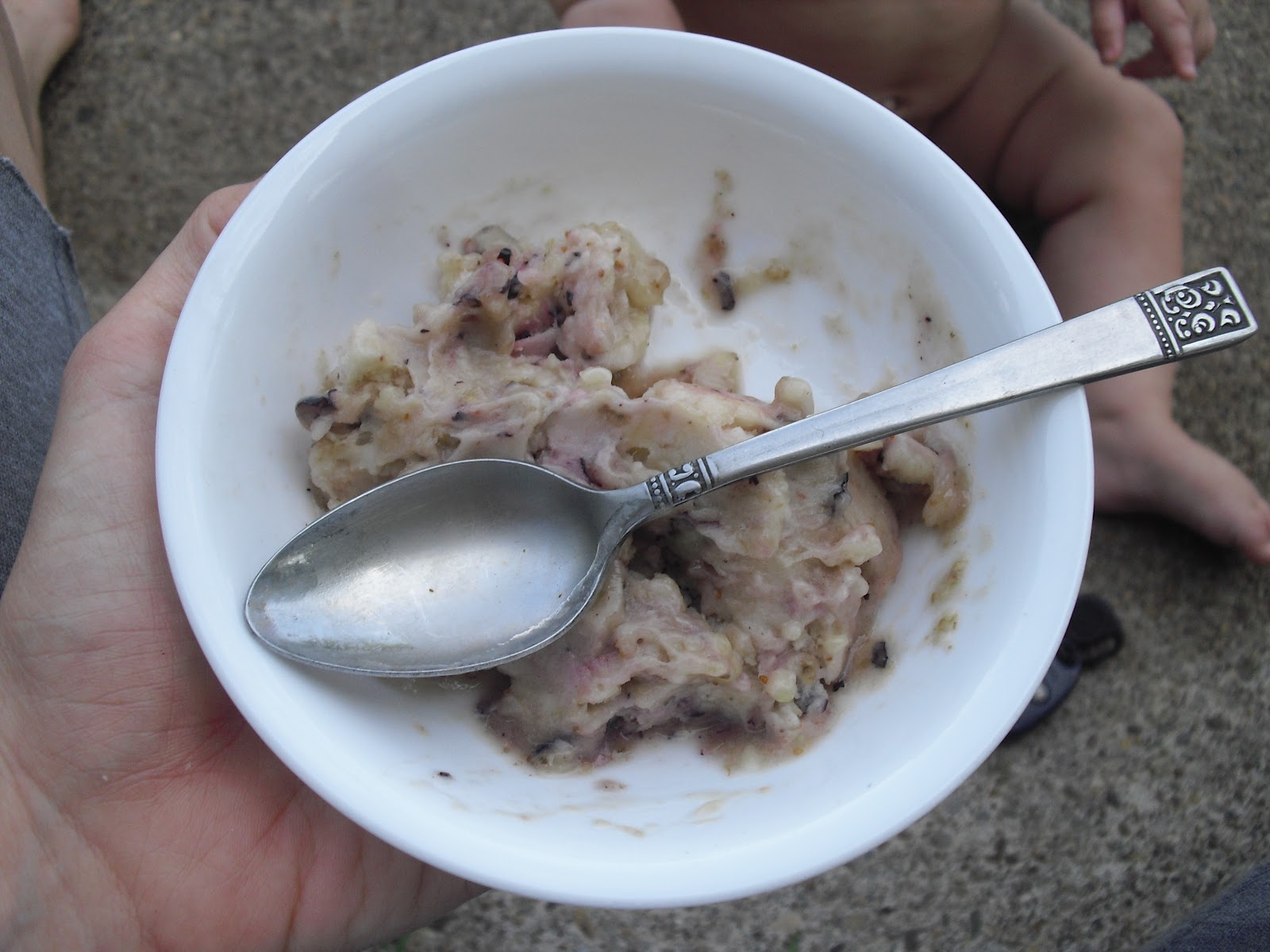
Our version of icecream is simply blended frozen bananas. This particular concoction is two frozen bananas and about a half a cup of blueberries.

The bananas are what give it the ice cream texture but any other fruit can be added for different flavors. Get crazy and add some spinach in there. You won't be able to taste it.

Don't forget to peel the bananas before you freeze them. Just trust me on this.

Does Evie know this is not "real" icecream? Heck no, and she loves it. Am I saying she will never get "real" icecream? No. I hate to break it to ya, but that crap on the grocery store shelves is not real icecream either. Take a look at the ingredients.


When she gets older we will have real homemade icecream. Why not now? What's the big deal about letting her eat sugary snacks?

We all learn our taste preferences. Taste buds are trainable. If I give Evie really sweet things at this age, she will develop a sweet tooth. The longer I can hold her off from tasting things like whipped cream, cookies, cake, etc. the more likely it is she will find the these things to be too sweet. Same thing with whole wheat stuff...I hope the day she tastes white bread she thinks "Ewww it's so mushy and bland!"

Her dad and I both have major food addictions and we have both struggled with our weight our entire lives. I was very obese from about 2nd grade through high school. I remember the humiliation of shopping and not being able to find clothes that fit, being twice the size of all my classmates, and feeling like everyone was staring at me and keeping track of how much I was eating at lunch. We only had gym 3 days a week in elementary school and I would lie awake every night before gym and worry. Sometimes I cried. I hated my body and I was mortified to have people look at me while I tried to maneuver it. I also remember devouring sweets as a way to deal with my feelings. It breaks my heart to look back at myself in those days.

I'm not saying you can't be fat and happy or fat and healthy or fat and sexy, because you definitely can. But I wasn't.

I want Evie to be healthy and enjoy nutritious foods for all the obvious reasons, but I also don't want her to ever feel like I did as a fat kid. I don't want her to grow up to struggle daily with "I want to eat that but I shouldn't." I want her to love and enjoy her body.

She already has genetics against her. She comes from a family of overweight over-eaters. I don't know how much of that is inherited and how much is learned, but I'm going to do everything I can to help her have a healthy relationship with food.


Monday, August 27, 2012

Columbus Food Truck Fest-Weekend Outing Preparation


We spent this weekend in Columbus at the Food Truck Fest. It was so much fun! We were selling our handmade jewelry, accessories, and pin back buttons. (You can check out some of our stuff here.) We met some awesome people and were lucky enough to have Ghetto Vintage as our neighbor.

This was our first weekend away from home since having Evie. I was surprised at how smoothly everything went. It used to be so stressful for me to leave the house when she was younger... so much to get ready, so many things to forget, and inevitably, spit up on all of us at least twice right before we were ready to walk out the door. Thank goodness, I've either gotten way better at preparation or she is getting easier to take care of as she is growing. Maybe a little of both.

Whenever we are going to be out for awhile, we bring a cooler packed with home-made food for Evie so we don't have to worry about finding something nutritious for her to eat in a restaurant or random grocery store. We keep several gallon jugs of water in the freezer so when we need ice we just throw them in the cooler. They sweat a little but don't melt like ice chips and make everything soggy. When they start to thaw, you can drink the water! The trick is not to fill the jugs all the way before you freeze them or they will burst as the ice expands.

I made a run to the grocery store Friday and prepared some things for her to eat. My arsenal included cooked oatmeal, hard-boiled eggs, grapes, a block of cheese, an avocado, some cooked mixed veggies (carrots, peas, corn, broccoli) all packed in recycled glass jelly jars. Of course, we brought lots of bananas. I packed too much food, which is always better than too little.

I steamed the veggies in my double boiler while the eggs were boiling in the water below. This saved time, energy, electricity, and water. If I didn't use the water to boil eggs, I would have saved it to cook the oatmeal. The water under the steamed veggies has lots of nutrients in it. It's usually green!


I also stuffed a jar full of celery sticks and water to keep them crisp and cool. She can't eat the celery yet but it's the best teether in the world. If she is having a really bad teething day I will give her frozen celery to chew on and it always makes her happy, at least for a little while.


Looks like she got a bit of grass on her celery stick!

Here she is, munching away, happy as a clam. She is such a good baby. It was miserably hot all weekend and she never even got fussy.


With our first weekend trip being such a success, I see more in our future, and that makes me a happy mama. 


Thursday, August 23, 2012

All Natural is a Joke

The problem: Labels lie!

The solution: Read the ingredients. 

Don't fall for the claims boasted on packaging. Healthy and all natural my fanny! The terms "healthy" and "natural" have absolutely no regulation or definition when it comes to the food industry, so they basically mean nothing. I could produce a completely artificial candy and claim it was all natural with no consequences.

I hate to be Debbie Downer here, but food companies are smart. They keep up on the hot trends and swoop in to profit from them. They know that people are starting to wake up and realize all this crap we are consuming is not good for us. So, they slap the word natural on the label and voila! Sit back and watch the profits sky rocket.

To figure out what's really going on with your corn flakes, all you have to do is flip the box over and read the ingredient list. This is one place where the companies can't lie. (Well, except by using terms like "natural flavoring," but that is a post for another day.)

Did you know that the ingredients are listed in order of quantity? For example, if the first ingredient is corn, the product is mostly corn. The rest are listed in descending quantities, so if the second ingredient is sugar and the last is salt, then you know there is more sugar than salt. You can get specific salt and sugar levels by reading the nutrition label.

Another trick they use is pseudonyms. For example, they know people are trying to cut back on sugar, so they call it something else. Dextrose, Sucrose, Fructose, Cane Syrup, Cane Juice, Maltodextrin, etc. This list goes on and on. One of the worst offenders is corn syrup, especially high fructose corn syrup. See my post on HFCS to find out why.

The easiest way to avoid all this nonsense is to simply not buy anything that has any ingredient your grandma would not have in her kitchen cabinets. We used to say no ingredients you can't pronounce, but the industry caught on and changed the ingredient names to sound less like chemistry class.

This isn't as hard as it sounds. Practice by reading the labels of what you already have in your kitchen. I bet you will be shocked by what is in at least a few of the products you thought you trusted. If you don't know what an ingredient is, Google it. The results might surprise you.

Try to shop in the produce and health food sections only. Avoid the middle aisles all together if you can because this is where most of the processed food is. You need to read ingredients in the health food section too.

Your first few shopping trips might be a little overwhelming. Leave yourself some extra time and maybe leave your spouse and kids at home so you can concentrate. If you are lucky enough to have a fancy phone, there are food additives apps that can help. It will get easier every time you go shopping.

Try to look at this as empowering instead of as another thing you have to find time for. You can take the power back over what your family eats. Shame on those corporations for trying to pull the wool over your eyes. Fight back. Remember, every dollar you spend is a vote for how you want to see the future.


Wednesday, August 22, 2012

Food Freak Out


If you are anything like I was 9 months ago, your pantry probably consists of convenience foods like boxed mac and cheese, instant mashed potatoes, and sweetened cereal. You eat some fruit and veggies every day and think you are doing pretty well at this whole healthy eating thing. For me, everything changed when I had my baby girl. Holding this tiny being who was completely dependent on me for her every need made me realize I was going to have to get it together before she started eating solid foods. I was not going to be one of those mothers sweating in the fast food drive-through with a guilty look on my face, hoping no one I knew saw me sneaking french fries and over the back seat to my toddler.

I thought it would be easy. I would start really paying attention to ingredient labels, switch brands if necessary, avoid the deep fryer, and smile smugly as my kiddo munched on some all natural cereal, just like in the glossy parent magazines. I was dead wrong. I was completely overwhelmed and unprepared for the rabbit hole I found myself falling down when I started to research the current state of our food. Red dye 40? Phenylpropionaldehyde Dimethyl Acetal? Genetically modified organisms? What was this crap and why was it in my dinner?

I spent countless hours learning about everything food related. At one point I freaked out and threw nearly everything in our kitchen into the trash. Yes, it's that serious. I know what you are thinking. If it isn't safe, it wouldn't be in our food. That's what the FDA is for. I used to comfort myself with that thought too. The sad truth is that in the United States, we assume things are safe until they are proven harmful. The growing chorus of people raising concerns about our food supply is mostly being ignored by those who have the power to do anything about it.

So what do you do? You take it one step at a time, one meal at a time. Some changes are easy and some are....not so easy. We have been on this journey for about six months and I'm proud of the changes we have made, but I know we have a long way to go. Despite my convictions and my pledge to feed my family real food, you may see me devouring a chocolate bar in the bushes, well hidden from the keen eye of my tiny tot who always wants a bite of whatever mommy is eating. Life is just like that. You do the best you can and you keep trying to do better. Then one day you wake up and admire how far you've come.

There are many excuses people (like me) come up with for leaving healthy eating at the bottom of the priority list. Here are a few of them.

  • Healthy food tastes like poo. This is so not true. We are eating better now than we ever have. Some things can take some getting used to, but our overall consensus is that our food tastes way better and is much more satisfying than what we were eating before. Plus, we have expanded our diet to include all kinds of things we had never eaten before...quinoa, millet, rainbow chard...and who knew you could make something other than jack-o-lanterns and pie with pumpkin?!

  • It's too expensive. I thought so too, and I have been pleasantly surprised that our food bill has actually gone down. Junk food is expensive, it gets gobbled up right away, and it doesn't keep you full. Whole foods may seem to have a higher price tag, but they fill you up more quickly and help you feel full longer. Strategies like buying in bulk and meal planning also greatly help reduce grocery bills.

  • It's too time consuming. Although some Super-Mom bloggers out there would have you think healthy eating happens in a snap, this is one area I have not yet mastered. (I suspect they have secret ties to Samantha the witch and often wonder how I can join the coven too!) I do spend a lot more time thinking about, planning, and preparing food than I used to, but it isn't nearly as difficult as I thought it would be and it's totally worth it. There are lots of time-saving tips that can help immensely.

  • It's impossible/too hard/overwhelming and I have no idea where to start. I completely understand. I wish someone had been there to guide me when I was having my food melt down. By sharing my family's experiences, both our triumphs and our miserable failures, I hope to help make the transition to healthier eating easier for anyone who wishes to do so. Each week I'll share tips, tricks, and information you can actually use to revamp your diet. No rocket science required.

Share your thoughts and questions with me. What do you find confusing about healthy eating? What roadblocks are in your way? What successes have you had so far?