Sunday, November 11, 2012

Evie's First Birthday and Whole Wheat Organic Sugar Free Cake


Whew. What a week! I am glad birthdays only come once a year. Now I know why my mom always looked like she'd been hit by a bus in my birthday party pictures.

I was getting a lot of pressure about how first birthdays are "supposed" to be. An entire cake for the baby to smash and eat all by herself, (a "real" cake!) and brightly colored icing to smear all over her face. Okay, but in my world, it also has to be whole wheat, no sugar, and no artificial dyes. Hmmm.


I ended up tweaking this carrot cake recipe to my liking and it was delicious. For the icing, I just put a block of organic cream cheese in the blender with a couple tablespoons of maple syrup and voila! I made two fruit syrups for the colors, one from mango and pineapple for yellow and one from blackberries which turned out kind of dark red. They yellow wasn't quite bright enough once I mixed it with icing so I added a bit of the spice turmeric, which worked like a charm and you couldn't taste it at all. You can read how to make the syrups here.

Here is the final recipe I came up with:

2 cups organic whole wheat pastry flour
1 teaspoon baking powder (make sure your brand is aluminum free!)
1 1/2 teaspoons baking soda
1 teaspoon sea salt
2 teaspoons cinnamon
3/4 cup organic unrefined coconut oil
3/4 cup maple syrup
4 organic free range eggs
2 cups grated organic carrots
1 cup organic raisins

Combine the first 5 ingredients in a large bowl. Add the eggs, maple syrup, and coconut oil. (Coconut oil becomes a solid at normal room temperatures. If yours is solid, you will have to melt it over very low heat before you can mix it in.) Lastly, add the carrots and raisins and mix again. Bake at 350 for 35 minutes, or until a toothpick inserted in the middle comes out clean.

For the party, I cut this recipe in half by 1/4 because I was just making a small heart shaped cake.


I seriously stressed myself out over what to feed the adults. It was going to cost a bajillion dollars to make enough of the above recipe to feed all our guests. I thought maybe I would just get an organic cake mix but then I read the ingredients and it was basically just white flour, white sugar, and baking powder and I would still have to add the expensive stuff myself so that was no help. I decided to just make a normal cake from scratch with as many organic ingredients as we already had in our pantry. So it ended up that everything was organic except the flour, and I did use white flour that we had left from our white bread days. I used organic cane sugar. A cake is a treat, not something you expect to meet your nutritional needs, so having white flour at a birthday party is not going to kill you. I didn't have enough time to perfect a whole wheat recipe with ingredients I could afford and I was honestly terrified that everyone would be standing around choking my crappy cake down thinking to themselves "I knew healthy meant gross." Hopefully next year I will be able to pull it off, but for now I just take comfort in the fact that at least my cake didn't have any bogus food additives or genetically modified ingredients. It was a cake my grandma would have been proud of. (Even though I burned the bottom a little!)


I got to thinking about the evolution of birthday cakes. Back in the day, they were baked from scratch by someone who loved and cherished you. Then along came cake mixes, which were also made with love, just less effort and time. Now, we have store bought cakes. Almost all of the cakes I have seen recently have been made in a store bakery. I know this sounds like some corny hippie crap, but there is something so sad about a Walmart birthday cake. Aside from the horrifying ingredients... something deeper. A cake is a symbol of love, a celebration of your existence. Something someone made in order to say "I am so glad you were born." The people working in the bakery at Walmart are probably getting paid minimum wage and hate their jobs. I can hear them thinking "If I have to make one more Sponge Bob cake I'm going to shoot myself." Maybe store bought cake contains some residual resentment. Maybe that's totally stupid, but I don't think so. I think it's just one example of what is wrong with what we eat. Corporations who care about profits, not people, mix and box most of the food we eat today. They are more concerned about sales and preventing spoilage and profit loss than they are about nourishing the people who buy their products. There is no love in our food.


 This is where buying locally, buying organic, and buying from small family owned companies can make a difference. Small organic farmers and companies take pride in making healthy food and carry the intention of making a nourishing product. Of course they want to make money too, but without putting profits before people. Cook from scratch whenever possible. It is so worth it.


Sunday, November 4, 2012

Cook Breakfast While You Sleep

Well, Evie's first birthday party today! My plan was to blog about it tonight and share the cake recipe, but it turns out that I greatly underestimated how tired I would be. So that will be next week.

This week I decided to share an overnight slow cooker breakfast recipe that we love from another blog. It was freaking amazing to wake up both Saturday and Sunday morning with breakfast already made! And it was delicious too. The first night we made pumpkin pie oatmeal. You can find the recipe here. I actually baked a pumpkin and used its poor old guts instead of using canned pumpkin like it calls for in the recipe, which was surprisingly labor intensive. We ended up sleeping in, so it cooked for about 10 hours and was still perfect, so don't worry about leaving it on too long.

The next night we decided to try apple cinnamon. We followed the same recipe, just used one cup of chopped apples instead of the pumpkin, and added some raisins. Next time I think I will add more apples. If you are used to eating super sugary stuff and these aren't sweet enough for you, you can always add a bit of maple syrup or stevia or (gasp!) sugar.

We will definitely be having these meals again, and many other variations I'm sure. Let me know if you come up with something tasty!

Thursday, October 25, 2012

Genetically Modified Organisms

This is a topic I have been reading about for months. It's one of those monsters that creeps into the back of your mind and is kind of always there, freaking you out so much that you just force yourself to not think about it. Researching for this post has been a nightmare. I can only read a little bit at a time without having to take a break and play on Facebook or look at cute pictures of baby animals. It's that intense.


What is a GMO? Genetically Modified Organism. I used to think this was like crossing a white rose with a red one to get a pink rose. That's not scary right? Unfortunately genetically modified foods are much more sinister. Scientists take DNA from one species and force it into the genetic code of another species, creating a whole new organism that would never have existed in nature. For instance, spider DNA has been put into goats with the hopes of being able to milk spider webs from the goats to make bullet proof vest material (I know this sounds like a bad science fiction movie!) You can fact check me over here at ABC News.

The danger to us comes in when our food sources are genetically modified. Bt (Bacillus thuringiensis) is a toxin produced by bacteria found in soil. Scientists were able to isolate the gene that produces the BT and force it into the genetic code of corn. Now every single cell inside the corn produces Bt toxin on its own, so any insect that tries to eat it dies because the BT makes the insect's stomach explode. This was also done with soy and cotton. Monsanto, the company behind these horrible ideas, assured us that Bt would only kill insects, not us.
"They claimed Bt-toxin would be completely destroyed in the human digestive system, so it would not have any impact at all. However, such was not the case. Doctors at Quebec's Sherbrooke University Hospital were shocked to find the toxin circulating in the blood of 93 percent of the pregnant women, 80 percent of their babies' umbilical blood, and 67 percent of the non-pregnant women they tested.10 Clearly, Bt toxin is not destroyed in your GI tract."- Source

A theory which is gaining more supporting evidence every day is that after eating this corn and soy, our stomachs begin producing Bt. We are becoming walking pesticide factories, poisoning ourselves on a daily basis. Remember how Bt kills? It explodes the stomach. Many researchers believe the skyrocketing numbers of autoimmune disorders such as irritable bowel syndrome and food allergies are the result of eating genetically modified soy and corn. Researchers have found small cracks in the walls of our intestines that should not be there, which allows undigested bits of food to get into our blood stream. When the immune system sees these invaders, it attacks. This explains why food allergies are becoming so prevalent, even in non GMO foods. Anything that leaks into the blood stream is seen as a threat and will set the immune system alarms off.

Have you ever wondered why we are so sick? There are obviously many things that contribute to our sorry state these days, but one of the biggies is GM foods. Many holistic doctors are reporting that when they "prescribe" a completely GMO free diet for their patients, all kinds of symptoms disappear. Everything from migraines to food allergies to exhaustion to infertility have been reported to improve or completely disappear when GM foods are removed.

A new study was just released that is so frightening it cannot be ignored. Again, my disclaimer that I hate animal studies, they are cruel and horrible and often useless. However, these animals have already suffered and died for us, so the least we can do is take note and change our lives accordingly. Warning, some disturbing pictures appear below. If you are sensitive you may want to skip them.

"Here are some of the shocking findings from the study:

• Up to 50% of males and 70% of females suffered premature death.

• Rats that drank trace amounts of Roundup (at levels legally allowed in the water supply) had a 200% to 300% increase in large tumors.

• Rats fed GM corn and traces of Roundup suffered severe organ damage including liver damage and kidney damage.

• The study fed these rats NK603, the Monsanto variety of GM corn that's grown across North America and widely fed to animals and humans. This is the same corn that's in your corn-based breakfast cereal, corn tortillas and corn snack chips." -Source


You might be wondering why the results are so immediate and shocking in the rats, but not in humans. Rats only live a few years, while we live about 80. Since GMO's were released in the mid 1990's, this means we have only been consuming them for 20% of our lives, while the rats ate them for their entire lifespan. The truth is that we have no idea what the long term effects on humans will be. In a few decades, we could all be walking around with tumors the size of basketballs, just like these poor little guys. That is, if any of us are still alive.

Corn and soy are dirt cheap, so companies use them for everything. Oil, sweetener, thickener, etc. It is estimated that 80% of all processed foods contain GMO's. That means anything in a box, bottle, or can. This time just reading labels won't protect you because GMO's do not have to be specified, so you never really know what you are getting. I just realized yesterday that there is corn oil in my chapstick! (It's even in infant formula. Shame, shame.)

The only ways to avoid GMO's are:

1. Buy organic. Certified organic produce cannot contain and GMO's.
2. Buy from a farmer you trust or grow your own food.
3. Look for the Non-GMO Verified symbol. Products with this symbol have been tested and certified to contain no GMO's. You will only find this in the health food/natural food section so don't bother looking for it on your Kelogg's Corn Flakes.


Why isn't the government protecting us? That's a big pile of stinky dog poo that I'm not going to wade through, but take a peek at the chart below to get an idea of where the smell is coming from. You can read about it in-depth here. Let's just say that many of the people in the high up government positions who should be looking out for us are former Monsanto bigwigs, and vice versa. Actually, President Obama promised to make labeling mandatory for GMO's during his first campaign, but instead he has done nothing except appoint Micheal Taylor, a former Vice President and lobbyist for Monsanto, as the Deputy Commissioner of the FDA (Food and Drug Administration). Hmmmmm. Now don't go thinking I'm saying you should support Romney...click here for an article on his ties to Monsanto. The craziest part about this scandal is that Romney and Obama both insist on all organic food for themselves and their families. So while they are turning a blind eye to the poisoning of our citizens, they feast on the purest food available. I guess you don't have to worry about pesticides and GMO's when you are a multimillionaire. Must be nice! Here is a petition you can sign to tell Obama to end the ties between the FDA and Monsanto.


I know this is all seriously mind blowing and you might feel like your brain is short-circuiting right now. There is an amazing documentary called Genetic Roulette which breaks this stuff down so it is easier to understand. I highly recommend it! You can watch for free until Oct. 31st. After that, it's $19.95 to buy a copy of the DVD. If you miss the free viewing deadline, check the website frequently because they often have free weeks sponsored by natural food companies. The link to watch the movie is: http://geneticroulettemovie.com/

Warn your loved ones about GMO's! Remember that every dollar you spend is a vote. Are you going to support companies that are knowingly poisoning us for profit?


Sunday, October 21, 2012

A Short Intro to GMO's

Just a short video to whet your taste buds for the topic of genetically modified organisms. I've been working on a GMO post for weeks and it's overwhelming, to say the least. I love what Robyn O'Brien has to say and how she breaks it down into easy to understand information. Give it a listen and start the process of letting your brain digest this craziness before we dive in deep next week.


Blueberries and Cream Oatmeal


When I was little I loved the instant packets of fruit and cream oatmeal. I'm sure I don't need to tell you that stuff is loaded with sugar and other icky things. It only takes a few extra minutes to make from scratch and it's delicious and good for you.

Checking the texture...

You can buy organic oats in several varieties...rolled, steel cut, etc. The nutritional difference doesn't matter much but the texture and cooking times do. Experiment and see what you like best. If you are a texture freak and don't like the way home cooked oats feel, try putting them in a blender or food processor BEFORE you cook them. They turn into oat flour. If you do this, you'll have to stir pretty much constantly while they cook with a whisk so they don't clump, but they don't take nearly as long to cook.


Who needs a spoon when you have a fist?

Cook the oats according to directions. Meanwhile, blend some plain yogurt and frozen or fresh blueberries in a blender for just a few seconds if you want blueberry chunks left or longer if you like it smooth. Once your oats have cooked, mix everything together and take a bite. If you find it to be a bit tart, add a little maple syrup. So good on a chilly fall morning.

Of course you can do this with any fruit. Bananas and cream and peaches and cream were my faves back in the day. You can do apple and cinnamon or brown sugar and maple syrup without the brown sugar. It still tastes great! I am ridiculously excited about an idea that's been floating around in my head the last few days... pumpkin spice oatmeal! I'll post the recipe if it's a success.

Yum.


Monday, October 15, 2012

No Knead Whole Wheat Bread Recipe


I don't know about you, but we find the cost of real whole wheat bread without any crap ingredients to be cost-prohibitive. Five dollars a loaf is the norm around here and we just can't spend that on something that is gone in 3 days. So...I have tried out a million different homemade bread recipes. I have had some disastrous results. The kind that at first made me laugh out loud but eventually had me near tears. I even tried a bread machine. Nope. The bread kept coming out extremely dense, hard, yuck.

 I finally said screw these recipes and started experimenting. I think what I have here is near perfection. It tastes soooo good and has turned out well every time. It has a browned crunchy crust and soft fluffy center. We pretty much devour at least half a loaf right when it comes out of the oven.


I'm not a fan of kneading (in fact, I'm kind of lazy....shhhh). It doesn't help that I have a little munchkin I can't take my eyes off for 5 seconds. Once she is big enough to help me, it might be fun, but for now, no-knead is the only way to go in my book.

Give it a try and let me know what you think. It's super easy and comes together in a flash. The hardest part is waiting for the dough to rise.

Oh before we start, a tip about flour. Regular whole wheat is darker and more intense tasting. We like it a lot, but what we like even better is the albino version of whole wheat. It is still the whole grain but it is called "white whole wheat." It's lighter and tastes more like white bread, but it still has the whole grain intact. This can be tricky at first so make sure you read the package to be sure you are getting whole wheat, not unbleached wheat. Look for that magic word "whole." Our local Kroger sells a generic store brand and also King Arthur brand. Our local bulk food store, the Bulk Food Depot, has organic white whole wheat in bulk.

Okay, on with the show.

You will need:

3 1/2 cups whole wheat or white whole wheat flour
4 tablespoons vital wheat gluten*
2 tablespoons active dry yeast
1 teaspoon salt (we use sea salt)
1/4 cup olive oil
1 3/4 cups warm water

Mix all the dry ingredients in a bowl. Fill a measuring cup with the warm water and then top it off with the olive oil. Slowly pour the liquid into the dry ingredients, stirring as you go. Once it is all mixed up, the dough will be very wet and sticky, unlike traditional dough.


Lightly cover the bowl or stick it in the cold oven to protect it from buggers and dust and let it rise for one hour. It will double in size and dry out a bit.


Next, shape the dough into a ball and separate it into two pieces. Shape them however you like...oval or round on a greased baking sheet or oven safe plate, or put them in a regular greased loaf pan, whatever you are going to bake them in. If you are not using a loaf pan, your ball or loaf will flatten out a bit while baking, so try to make it tight. Cover or return to cold oven and let rise again for another hour.

After that second hour has passed, preheat your oven to 450 (take the bread out if you were letting it rise in there!). Put a baking sheet on the bottom shelf to preheat as well.

Gently rub some water over the top of your loaves, sprinkle with flour if you want that arisan look, and cut slashes in the top. This allows the bread to keep rising even after the crust has started to form so you get fluffier bread. (Part of the reason I was getting dense loaves before was because I skipped this step since it seemed like a waste of time to me. I'm one of those people who has to know why I am doing something or I'm not likely to do it. Yes, I make my own life difficult!)


When the oven is heated to 450, put your bread (either in the loaf pan or on the baking sheet) on the top rack, and then dump a cup or so of water into the preheated baking sheet on the bottom rack. The water  steams the outside of the bread as it cooks.


30-35 minutes later you have perfect yummy bread. I like the crust really crunchy so I leave it in a little longer. Just try not to eat it hot with some butter....mmmm.....my mouth is watering thinking about it.


*What the heck is vital wheat gluten? Gluten is the protein part of wheat. It can be found in some grocery stores or online. It helps the dense whole wheat rise and fluff up. Don't skip this ingredient or you will have brick bread!


Sunday, October 7, 2012

White Bread Blues

I love bread. It might be my favorite food. Soup, chili, spaghetti, you name it, I want bread with it. You could call it an addiction, and you'd probably be right.

I have known white bread is bad for a long time and thought I was eating whole wheat bread because the bread I bought at the grocery store was brown. Ha! If only it could be so simple. It turns out that the "wheat" bread on the shelves is actually white bread with caramel coloring. Yep, you read that right. Technically all bread is wheat bread, because it all comes from wheat flour. White flour has had the nutritious parts of the wheat stripped away and is then "enriched" with fake chemical vitamins and minerals which are actually really hard on our bodies. And the caramel coloring? It's not heated sugar like gradma used to make. It's a chemical cocktail including 2-methylimidazole and 4-methylimidazole, which have been proven in govermnent-led studies to cause cancer in animals. This coloring is also in soda and many other processed foods.

Even if the bread label says "100% Wheat" it could still be made with white flour. It has to say "100% WHOLE wheat." If the word "whole" is not there, don't buy it. (Whole grain is also okay...that just means they used whole grains other than wheat such as oatmeal, bulgur, etc.) Be sure to read the ingredients. Just because it really is whole wheat doesn't mean there aren't a bunch of crazy toxic food additives lurking in there. Companies often try to make wheat bread fluffy and light like white bread, which is difficult to do without help from our friend the chemist.

Here are the ingredients in a typical so-called wheat bread:

INGREDIENTS: Enriched wheat flour, [flour, barley malt, ferrous sulfate (iron), “B” vitamins (niacin, thiamine mononitrate B1), riboflavin (B2), folic acid)], water, high fructose corn syrup, corn syrup, yeast, soybean oil, contains 2% or less of: salt, wheat gluten, soy lecithin, calcium sulfate, dough conditioner (may contain: sodium steroyl, lactylate, datem, mono and diglycerides, calcium dioxide and/or dicalcium phosphate), cornstarch, wheat starch, ammonium chloride, ammonium phosphate, caramel color, natural flavor, enzymes, calcium propionate and TBHQ (to retain freshness) 

Yikes! Google some of that stuff and I bet you won't want to eat it again. TBHQ is a form of butane. Even just the amount of ingredients is shocking considering you can make bread at home with only four ingredients: flour, water, yeast, and oil.

If you can afford high quality whole grain bread, go for it! If it's it too expensive for you or just can't find any without scary food additives, don't despair...I am on the verge of whole wheat no-knead bread perfection, and I will post the recipe next week!


Monday, October 1, 2012

Oven Roasted Crispy Kale


Can you believe I had never eaten kale until about 6 months ago? (The world's worst vegetarian!) The first time I had it, I steamed it with some garlic and lemon juice, and it was disgusting. I'm so glad I gave it another try in the oven. It's one of my favorite side dishes now! I actually crave it if it's been awhile since we've had it.

It's super easy and quick. All you do is:
  • Wash your kale and trim it into bite size pieces. (Most people say to trim away the tough stem in the middle, but I like it.) 
Raw kale

  • Spread the pieces out on a cookie sheet and drizzle a tablespoon or so of olive oil around and then rub each piece around on the cookie sheet to kind of coat them. You don't want them drenched, just a tad shiny.
  • Sprinkle them with whatever spices you like. We do garlic powder, lemon pepper, and a little salt. 
  • Pop them into an oven preheated to 350 for about about 20 minutes. Keep peeking in to see how they look. I like to let the edges get completely dark so they are super crunchy, but you might like them softer. 
Crispy kale. Yum!

They are so yummy, I swear I could eat them every day. I made this for a friend and her teenage niece one night and a few days later, the 16 year old texted me and asked for the recipe. If that doesn't spell success, I don't know what does!

Surprisingly, Evie likes them too. She and I can finish a whole pan all by ourselves! I tried to give her steamed kale before but she kept spitting it out.


Sunday, September 30, 2012

Green Eggs and Scram


I'm not a fan of "hiding" veggies from your kids. You know, all those helpful hints in magazines like "Put cauliflower puree in mashed potatoes, they will never know!" As if that's a good thing. What are the chances they will hide veggies from themselves when they grow up and cook their own food? It's important to teach kids to like vegetables. That can be hard to do if you don't like them yourself. I have found that how a vegetable is cooked makes all the difference. I can't stand steamed spinach or kale or carrots. Uggh. Slimy and just....yuck. However, kale baked in the oven is amazing! Spinach and carrots are both great raw in salads or blended up in smoothies.

If you think you don't like a vegetable, try different ways of cooking it and see what works.

These eggs are so easy and fun, especially if you have recently read Green Eggs and Ham. All you do is put some raw eggs in a blender with a bit of yogurt and a large handful of spinach. Blend it all up and then cook it in the skillet just like an omelet. They turn a vibrant green and taste delicious. If you child is older and likes spices, you can add garlic and basil too.

As you can see, Evie loves them!


Obviously we don't eat ham, so I'm still trying to come up with what exactly the "Scram" part of our Green Eggs and Scram will be. Possibly just a hug and a swat on the tush as I shout "Scram!" while cleaning up the dishes after breakfast.


Monday, September 24, 2012

Is Organic Really Better for You?

You have probably heard on the news that a new study found organic produce to be no more nutritious than conventional produce. The basic message was "don't waste your money on organic." This is a perfect example of how facts can be manipulated to purposely deceive us into feeling safe when we are actually in great danger.

I have never heard anyone claim that organic food is more nutritious. High five to those researchers for totally missing the point! The reason organic food is better for you is that it contains little to no pesticide residue or traces of antibiotics, and it is never genetically modified. This was actually admitted in the new study. However, the media chose to only shine the spotlight and bellow in the bullhorn that there is no nutritional difference. If you want to read an in-depth critique of the study, this is a good one.

Pesticides are sprayed all over fruits and vegetables, not to repel, but TO KILL anything that tries to eat them. (Pesticide, homicide, suicide...hmmm...) It's absolutely insane to think that this does not affect us. While we obviously don't immediately drop dead like bugs do, we are getting low doses of these toxic chemicals every single day.

This is an actual picture of a worker handling Monsanto's Lasso, which is an herbicide used on corn and soy crops. Do you think they feed their children what comes from these fields? I doubt it.

While I hate to quote animal studies, as they are horribly cruel and often pointless, this fact sheet on Lasso shows exactly why we need to be alarmed. Remember, this is just one of the chemicals dumped on our food. According to Sustainable Table, there are 5.1 billion tons of insecticides (to kill insects), herbicides (to kill weeds), rodenticides (to kill rodents), and fungicides (to control fungi, mold, and mildew) used every year.


http://enotablog.com/tag/eco-village/


Here is an awesome video of a simple science experiment a young girl did with sweet potatoes. The results are pretty shocking. I don't want to steal her thunder so just watch it before you read on. It's only 2 1/2 minutes long.


So, basically, she found that the conventional sweet potato from a chain grocery didn't sprout at all, ever. The store manager told her it would never sprout because it had been sprayed with Bud Nip. The supposedly organic one from the chain grocery store sprouted wimpy vines after a month. The organic one from the local organic market sprouted huge vines in just a week. Of course this is not a controlled study, but it does make you think.

According to Pesticide Management Education Program:
"Bud Nip (Chlorpropham) is moderately toxic by ingestion. It may cause irritation of the eyes or skin. Symptoms of poisoning in laboratory animals have included listlessness, incoordination, nose bleeds, protruding eyes, bloody tears, difficulty in breathing, prostration, inability to urinate, high fevers, and death. Autopsies of animals have shown inflammation of the stomach and intestinal lining, congestion of the brain, lungs and other organs, and degenerative changes in the kidneys and liver."
It's funny the media didn't mention that! Please don't be fooled by these sneaky tactics. I know it's tempting to think organic doesn't matter, especially with the cost of groceries (and everything else) rising rising rising. Like many others, the recession has hit our household hard. We have had to make tough decisions and cut out many things we enjoy simply because feeding Evie is our top priority. Kids are so small and their systems are so new that toxins, pesticides, etc. are much harder on them. Everything inside them is still developing. Once in awhile I will buy non-organic food if she is not going to eat it, but we try to eat all organic whenever we can afford to so that we will be around a long time to watch her grow up.
The Environmental Working Group puts out a guide to the most and least contaminated fruits and veggies. They call it the "Dirty Dozen" and the "Clean 15." I have found this to be a wonderful resource. Can you guess which fruit is the worst? It's the apple! Click here to to see the whole list. You can download the guide from their website and they even have a Iphone App to use while shopping. Of course if you are like me and don't have such fancy gadgets, you can print out the guide and take it with you. :)


Monday, September 17, 2012

What is Causing Early Onset Puberty?

A friend recently sent me a message on Facebook, asking if I knew why girls were starting their periods so early these days. I remember some talk about this when I was a kid. Most of my friends began menstruating around age 11 or 12. Our parents talked in hushed voices about how young we were to be going through this.

A quick Google search left me with my mouth hanging open...apparently it's becoming quite common for girls to start going through puberty at age 7 or 8 now! This is only, at the most, 20 years since my coming of age. What in the world is going on?

Several factors are thought to be contributing to this disturbing trend.

    A cow with Mastitis
  • Hormones in dairy products and meat. In order to increase profits, dairy farmers inject cows with a synthetic hormone that makes them produce more milk. This leads to painful swelling and bacterial infections in the cows udders. They give them antibiotics to combat the infections. Guess what that means? The hormones, the antibiotics, and the pus from the infected udders all end up in your milk. Yum. Back in the 1950's, dairy cows produced 5300 pounds of milk in one year. Now, they produce 18,000 pounds a year. The same is true for animals raised for meat. The farmers want them to grow as quickly as possible so they can send them off to slaughter and get paid. The hormones end up in our bodies and make us grow more and grow faster as well. They are also suspected of causing cancer. It's interesting to note that the European Union has banned the use of these hormones and even banned imports of beef from the United States because of the hormone use here. Organic dairy and meat do not use any synthetic hormones. However, as a former vegan, you will never hear me suggesting that you eat meat. As for dairy, I now feel that a little bit is okay, especially for babies and children, but if you really think about it...cow's milk is meant for baby cows, not adult humans. Try other types of milk instead...rice milk, almond milk, cashew milk, oat milk, hempseed milk, etc. (Notice I didn't say soymilk! Keep reading.)
 
Normal chicken on the left, chicken hopped up on growth hormones on the right, from the fabulous movie "Food Inc."

  • Soy products. Soy contains phytoestrogens, which are chemicals that mimic the hormone estrogen. Estrogen is a hormone that naturally occurs in our bodies. However, high levels of estrogen have been linked to breast cancer and are suspected of causing girls to mature faster. Soy is a cheap form of oil and it is in almost every processed food on the market. There is much debate about whether soy is a health food or a hazard, and whether fermented is better than non-fermented. I will be writing an in depth post about this in the future. For now I will say avoid non-organic soy at all costs. It is almost always genetically modified. Limit your soy intake. 
 
    Source
  • BPA and other endocrine disrupting chemicals. BPA stands for Bisphenol A, which is a chemical widely used in the plastics industry. Up until a few years ago, baby bottles, sippy cups, teethers, and toys contained this chemical. Public outcry has led to removal from most baby products, but it's still surrounds us in everything from store receipts to the lining that coats the inside of canned food. BPA is not the only offender. These hormone disrupting chemicals are everywhere and it's nearly impossible to avoid them. Flame retardants in furniture and children's pajamas, chemicals in shampoos and makeup, even air fresheners and fragrances...think twice before taking a big whiff of that smell good stuff. It could make you very sick. The worst part is that no safety testing is required before the chemicals are put into consumer products. Reduce your exposure by avoiding plastics as much as possible. Don't EVER microwave food in plastic or put plastic through the dishwasher, even if it says you can on the package. High temps allow the chemicals to leech out into your food. (Just don't ever microwave food for that matter!) We reuse glass jars for food storage (even though the lids do have coating with BPA). We reheat food using the stove or oven. I threw our microwave in the trash years ago. Also, avoid canned food when you can due to the BPA in the lining coating.

Source

This article from MSNBC talks about a girl who began going through puberty at age 7. Her parents and her doctors decided to take drastic measures to slow her maturation. According to the article, "She now has an implant placed under the skin of her upper arm that doles out regular doses of a drug that blocks the spiking hormones that were taking her into early sexual maturity." The thought of a nation of seven year old girls walking around with implants in their arms sends chills down my spine. We have to prevent this from happening to our children.

This is truly a topic big enough to write a book on. I hope I've given you a thorough overview and I encourage you to do your own research. Here are a few websites that contain great information. I know it's easy to get overwhelmed and stick your head in the sand. Just take it one step at a time and keep reminding yourself why you are making these changes.

Plastic-free Living Guide- This is an amazing resource and blog by an inspiring woman who pledged to cut plastic out of her life. We can all learn a lot from her!

Slow Death By Rubber Duck- This is a very informative hour long radio show interview. Here is the description from the station website: In their new book, Slow Death by Rubber Duck: The Secret Danger of Everyday Things, Canadian environmentalists Rick Smith and Bruce Lourie write that "we're all marinating in chemicals every day." Smith and Lourie spent a week exposing themselves to the common household chemicals found in furniture, shampoos, paint, electronics, cookware, and canned foods. They slathered themselves with shaving gels, ate from microwaved plastic containers, cooked in Teflon pans, plugged in air fresheners, and slept on flame-retardant laced furniture — then they tested their blood for levels of chemicals like Bisphenol A (BPA), mercury and phthalates. This hour, Lourie and Smith discuss their findings and the health risks posed by everyday products.

Dr. Oz- I'm not a Dr. Oz freak. This is actually the first one of his shows I've seen, but it's a good one. It's three segments, divided so you have to watch commercials between each one. Annoying, yes, but still worth it. All 3 segments only add up to about 15 minutes, so this is a quick watch.

Take Action- Last but not least, go here to use all that outrage you just mustered up to sign some petitions and make your voice heard. Change will not happen unless we demand it.


Monday, September 10, 2012

Waxing Insanity


I snapped this picture with my phone camera at Kroger a few months ago. It was gone the next time I went shopping, so they must have just had it up for a mandatory brief period.

I was honestly completely shocked. I had not heard of this waxing before. I went home and did some research, sadly discovering that even the organic produce is covered with this stuff. The worst part is that it's not always shiny, so it's very difficult to tell if what you are buying has been waxed.

It's mind-blowing to think that even fruits and vegetables are not vegetarian anymore. Shellac is a secretion that comes from bugs. You would think they might not have to kill the bugs to get it, but I found this on the Vegetarian Resource Group website:

"According to an article by Ramesh Singh, Department of Zoology at Udai Pratap Autonomous College in India, 300,000 lac insects are killed for every kilogram (2.2 lbs.) of lac resin produced. Approximately 25% of all unrefined, harvested lac resin is composed of “insect debris” and other impurities according to the Shellac Export Promotion Council." 

Doesn't this disgust you? Not to mention the fact that the wax has petroleum in it! You think you are doing your body a favor by eating fruits and veggies and yet you are ingesting crushed bugs and oil industry byproducts. Awesome.

I've read that you can dissolve most of the wax by soaking your produce in a mixture of half water, half vinegar for 10 minutes and then rinsing well.

The only way to avoid the wax is to buy frozen produce, or shop locally and eat in season. The wax is used to help keep produce from rotting when it is shipped across country or sometimes across the world so that we can have fresh tomatoes in winter when they cannot grow here.  So if you are buying from someone who grew the food near your town and picked it from the garden that morning, there is no need for wax.

You can go to the Local Harvest website to search for farmers' markets and other sources of local food in your area.


Thursday, September 6, 2012

High Fructose Corn Syrup is Evil and It's Taking Over the World

The problem: More and more evidence is cropping up showing that high fructose corn syrup is dangerous, and it's in nearly every processed food on the market.

The solution: Read ingredient labels and choose products with no sugar or at least with more natural forms of sugar. Please DO NOT buy anything containing artificial sweeteners such as aspartame. Look for maple syrup, molasses, or if you must, plain old cane sugar.

The corn syrup producers just recently tried to change it's name to the more innocent sounding "corn sugar," but luckily, the FDA said no. They are full of lies about how HFCS is not bad for you. Don't fall for it!

Not only is HFCS suspected of contributing to obesity, diabetes, and heart disease...it also often contains mercury! As if that weren't enough, it is almost always made from genetically modified corn.

HFCS is obviously used to sweeten colas, cereals, and cookies. It's also lurking in places you would never expect like ketchup, bread, canned soup, and boxed stuffing! The average American consumes 12 teaspoons of HFCS a day. Now that's scary.

I'm not going to reinvent the wheel here, many articles already exist explaining the dangers of HFCS better than I can.  Here is one of my favorites.


An Egg a Day Keeps the Doctor Away


It seems like a new study comes out every other day either for or against eggs. Are they good or are they bad? The answer depends on where they come from. Truly free range chickens who are allowed to wander around and eat naturally produce eggs that are packed with many nutrients. Chickens kept in cages and fed chicken "feed" produce less nutritious eggs which are often contaminated with antibiotics. These chickens are raised in very unsanitary, sad conditions. Not only do you not want to eat their eggs, you also don't want to support the industry that exploits them for profit.

Typical set up of egg-laying hens. They live in these cages their entire lives, never able to spread their wings and never ever see sunshine or touch grass.

You have to be very careful when buying eggs because the labels are purposely deceiving. "Free Range" legally only has to mean the chickens are allowed out for one hour per day, and this is rarely, if ever, enforced. "Cage Free" often means the chickens all live crammed in one giant building with no room to get away from the others. This often leads to horrible fights and even canabilism.

"Cage Free"-As you can see, they are not much better off than the caged hens. Eggs from these ladies could be labelled "Free Range" if the owners claim to let them outside once a day, even if that is a lie.


Eggs from happy chickens truly are good for you. They are excellent sources of protein for people who don't eat meat (like us!) because they contain many vitamins, such as B12, which are often lacking in vegetarian diets.

So, how do you find happy chicken eggs? Find a local farmer! Some small grocery stores carry "farm fresh brown eggs" from locals. Here in Athens we have them at the farmers' market, the health food store, a beauty parlor, and the drive thru coffee stand, just to name a few places. Find out where your eggs are coming from, don't just trust the package. It's best if you can form a personal relationship with your egg supplier so you truly know you can trust him/her.

Of course, you could start raising chickens yourself! It's not as crazy as it sounds. Lots of people are doing it these days, and we plan to as well once we find a place with more land. Check your local library for books on raising happy chickens. :)


Why I'm Always Hatin' on Sugar...Plus, Healthy Ice Cream


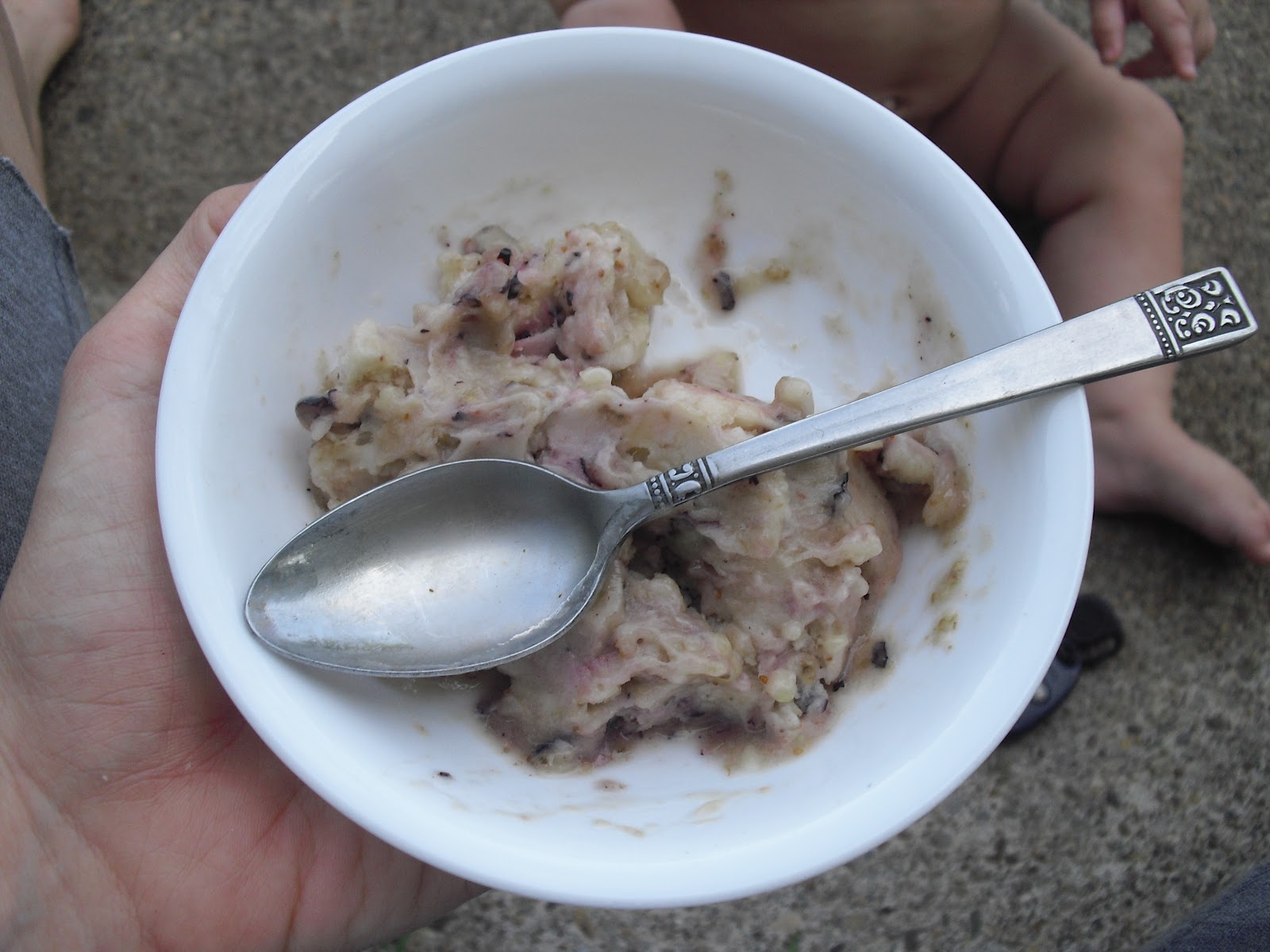
Our version of icecream is simply blended frozen bananas. This particular concoction is two frozen bananas and about a half a cup of blueberries.

The bananas are what give it the ice cream texture but any other fruit can be added for different flavors. Get crazy and add some spinach in there. You won't be able to taste it.

Don't forget to peel the bananas before you freeze them. Just trust me on this.

Does Evie know this is not "real" icecream? Heck no, and she loves it. Am I saying she will never get "real" icecream? No. I hate to break it to ya, but that crap on the grocery store shelves is not real icecream either. Take a look at the ingredients.


When she gets older we will have real homemade icecream. Why not now? What's the big deal about letting her eat sugary snacks?

We all learn our taste preferences. Taste buds are trainable. If I give Evie really sweet things at this age, she will develop a sweet tooth. The longer I can hold her off from tasting things like whipped cream, cookies, cake, etc. the more likely it is she will find the these things to be too sweet. Same thing with whole wheat stuff...I hope the day she tastes white bread she thinks "Ewww it's so mushy and bland!"

Her dad and I both have major food addictions and we have both struggled with our weight our entire lives. I was very obese from about 2nd grade through high school. I remember the humiliation of shopping and not being able to find clothes that fit, being twice the size of all my classmates, and feeling like everyone was staring at me and keeping track of how much I was eating at lunch. We only had gym 3 days a week in elementary school and I would lie awake every night before gym and worry. Sometimes I cried. I hated my body and I was mortified to have people look at me while I tried to maneuver it. I also remember devouring sweets as a way to deal with my feelings. It breaks my heart to look back at myself in those days.

I'm not saying you can't be fat and happy or fat and healthy or fat and sexy, because you definitely can. But I wasn't.

I want Evie to be healthy and enjoy nutritious foods for all the obvious reasons, but I also don't want her to ever feel like I did as a fat kid. I don't want her to grow up to struggle daily with "I want to eat that but I shouldn't." I want her to love and enjoy her body.

She already has genetics against her. She comes from a family of overweight over-eaters. I don't know how much of that is inherited and how much is learned, but I'm going to do everything I can to help her have a healthy relationship with food.